From Jean's desk, it's Monday Mojo. Inside Wasserle, the Bavarian cleaning company that grew to 500 people by choosing which customers to say no to.
Last week I was back in Germany.
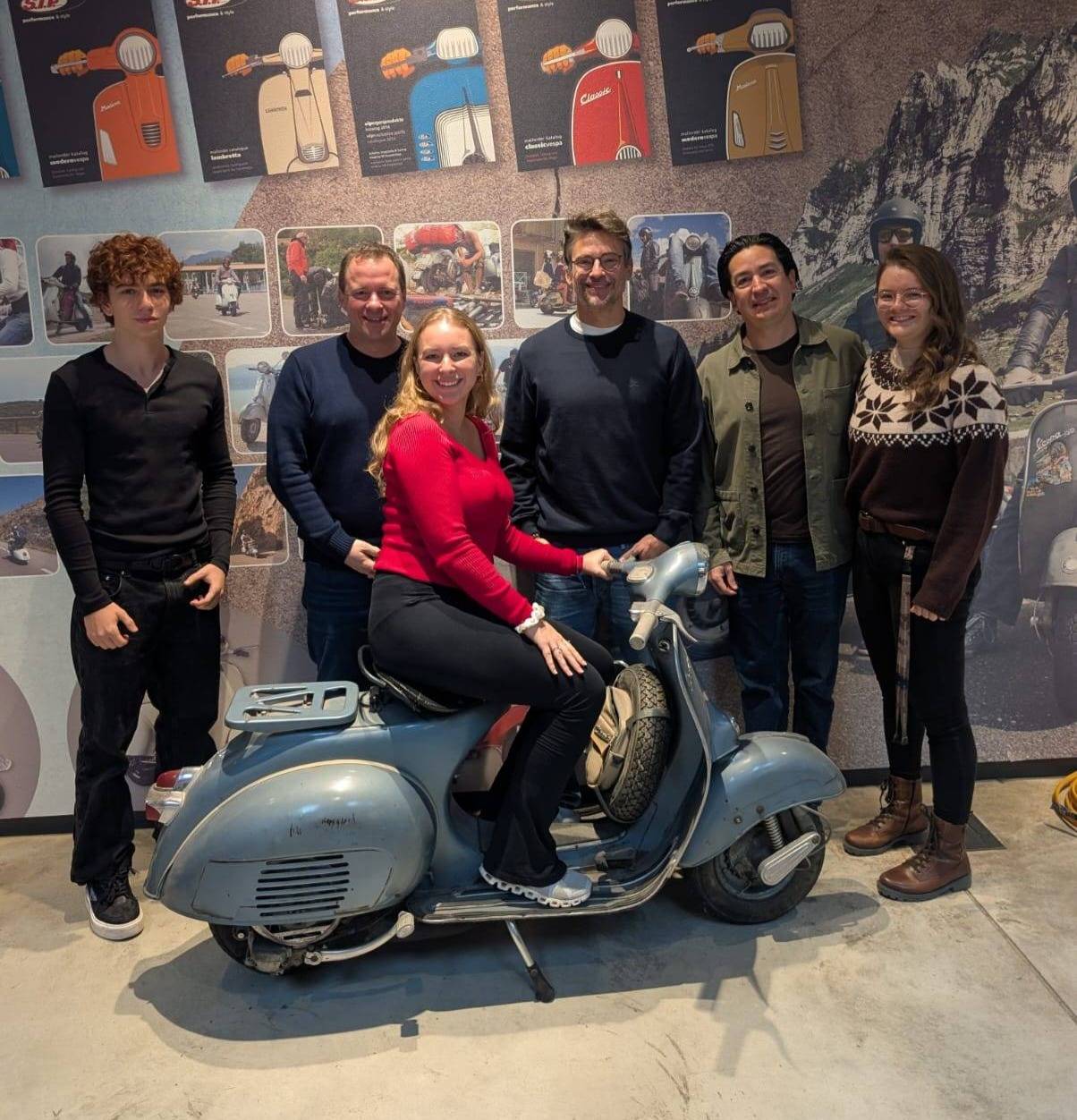
The last time I was there, I went to Kaufering on my own to scout a cleaning company I’d heard too much about to ignore. One day with Markus Wasserle and I knew I had to bring people back. So last week I did. A small group of us travelled to Bavaria for our first European Passport, with visits to Wasserle and SIP Scootershop.
SIP is next week’s story. This one is all Wasserle.
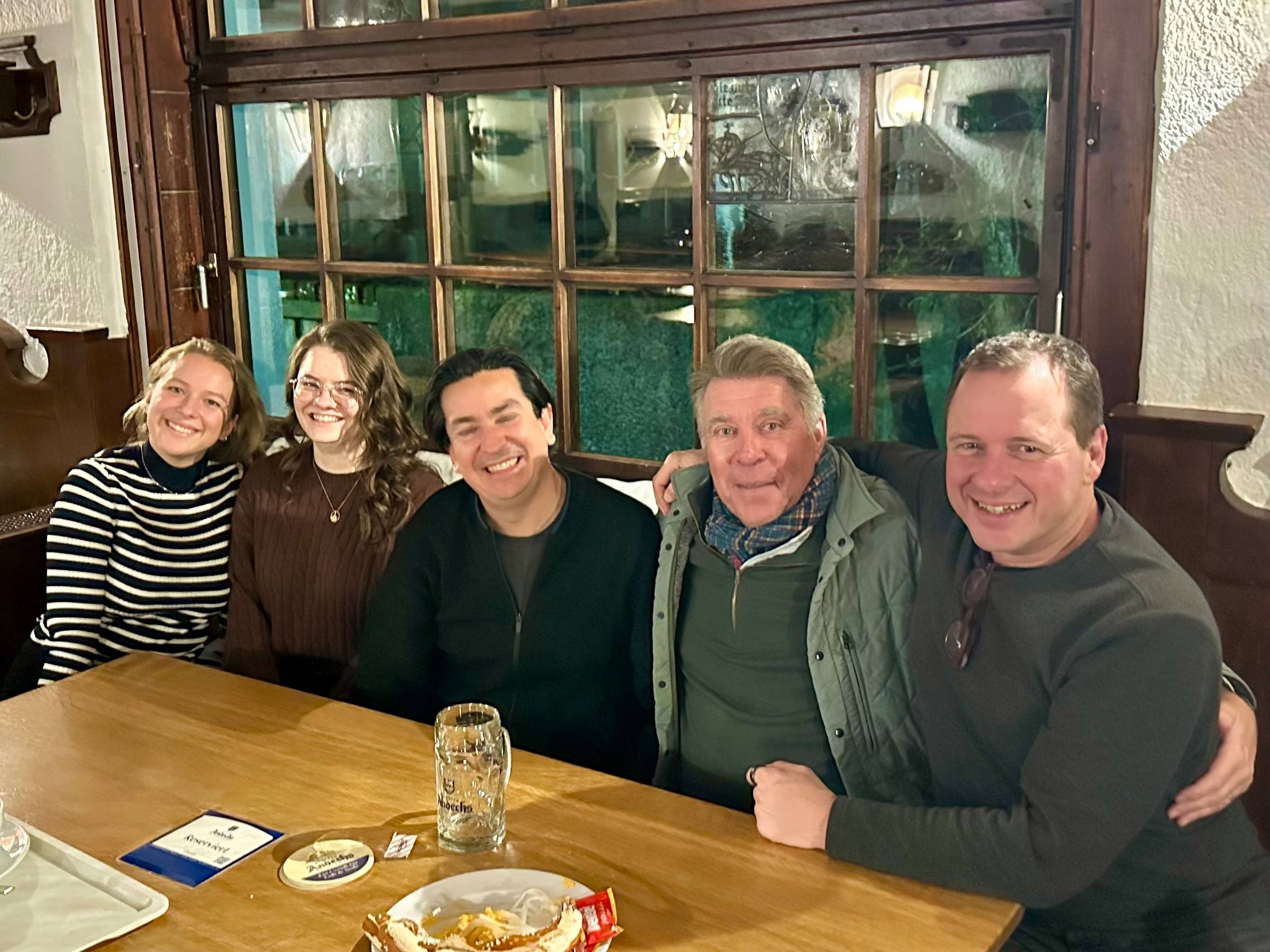
Some of you will know Markus already. He was at the Summit last year and at the Passports at Text-Em-All and Venturity, with his daughter Valerie.
For those who haven’t met him, Markus Wasserle trained as a mechanic. At 21 he took a job cleaning school buildings and, to his surprise, liked it. He liked the before and after. You could see the result of the work you’d done. He liked the people he worked with. And he noticed something about cleaning that he’s never let go of: it’s easy to learn. If you arrive in Germany with no language and no qualifications, it’s the quickest way to earn your own money and find your way into a community.
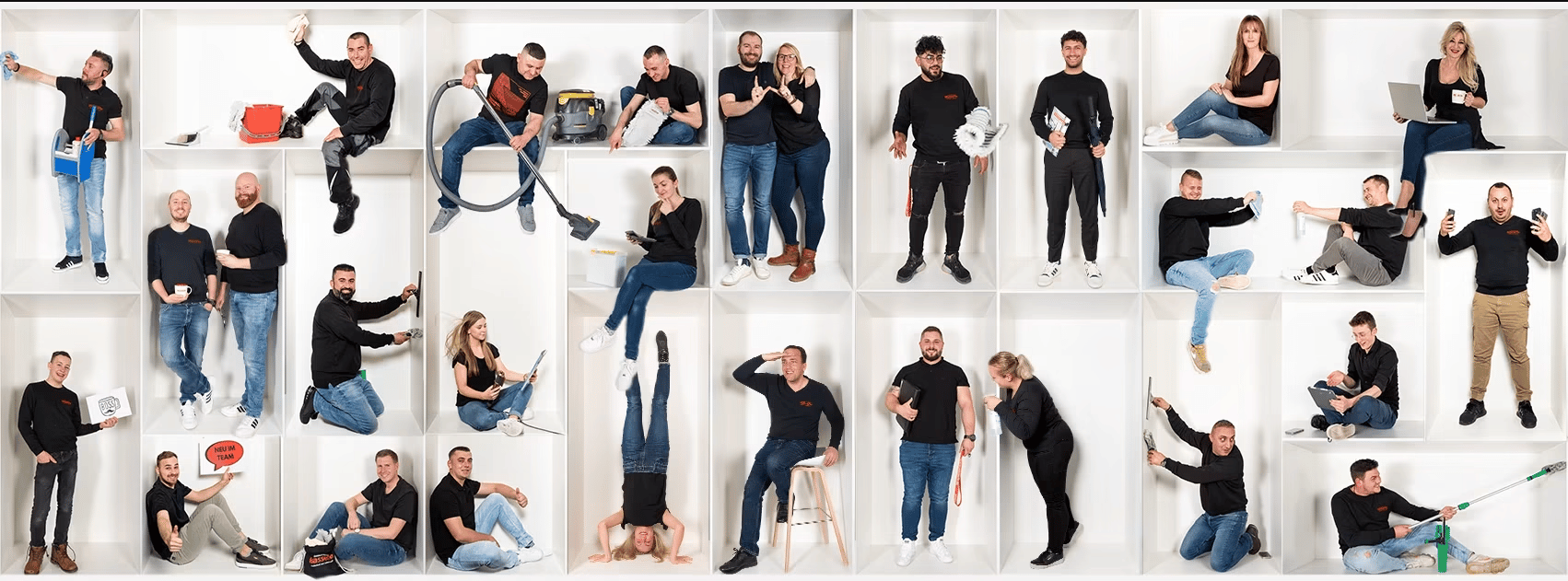
Markus founded Wasserle in 2004 with no customers. Today it has 500 people and 23.8 million euros in revenue. It grew 20% a year through Covid. It carries no debt and leases nothing; the 15 lifts the window cleaners use cost three million euros and were bought in cash. This year the Bavarian economy ministry named Wasserle one of the 50 best companies in the state.
Markus told us he writes down all the targets for his life, and the most important one is to develop people. Everything else, the company included, is in service of that.
"The company is an instrument to do it"
He’s thought hard about stopping where he is. He could. The business makes more than he needs, and he’s blunt about what more would even buy him.
"We have enough. I have enough to eat. I have a warm home. I could not eat more than I need."
But a company that stops growing has nowhere for young people to go, so the plan is to double revenue in the next ten years. Not 10x in three. Double in ten, and keep the culture exactly as it is.
For the first four years Markus took any work he could get: households, hotels, anything. He was miserable. Then he came across the Engpass idea, a German strategy concept that says pick the one customer whose need you can meet better than anyone, and say no to everyone else.
Today ten companies ask Wasserle for a quote. Five get one. Three become customers. Even their website is written so the wrong ones never call.
The right customer is an insurance company or investor with a portfolio of office buildings, where Wasserle can be on site six to eight hours a day. That matters for a reason that has nothing to do with the customer. Most cleaners in Germany work two jobs because no single one pays enough. Markus wants Wasserle to be the first employer, the one that gives people a full day. So he only takes customers whose buildings let him do that.
Twice a year every customer gets the net promoter question: how likely are you to recommend us? Nine or ten, fine. Seven or eight, a conversation. Six or lower, Wasserle cancels the contract. If the low score is Wasserle's fault they apologise and fix it. If it's the customer's building, their security rules, their two hour cleaning window, and there’s no way to make them happy next year, Wasserle walks. He’d rather lose the contract than lower the standard.
And the quickest way to lose Wasserle altogether? Be unkind to one of their cleaners. In Markus’s words, that is “the safest way to cancel the contract.”
Wasserle has a plan for every one of 500 people. Do you have one for your top five?
The Leadership Academy. Nine months with leaders who are building companies like this one.
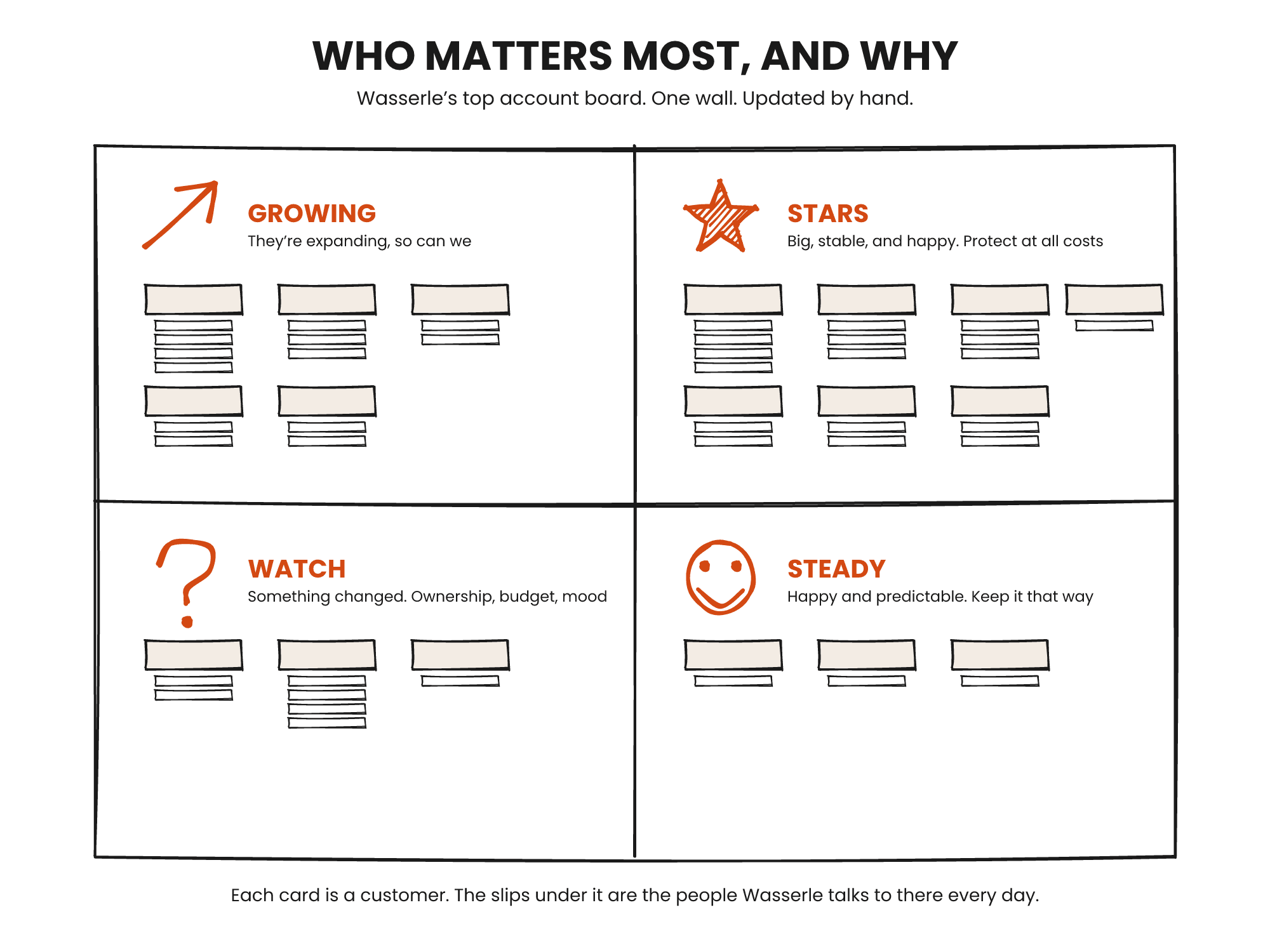
This is my rob and deploy for the week. In Fabian's office, Fabian being the man who finds new customers, there's a wall of black panels split into four. Every top account has a card. Under each card are slips with the names of the people Wasserle talks to there every day.
The star quadrant holds the big, stable, happy accounts. The arrow holds the ones that are growing, where there's room to grow with them. The question mark is the watch list: one of them is a robot maker in Augsburg that was bought by a Chinese group a few years ago, and the work has been shrinking since. The smiley is the steady accounts that just need looking after.
It's not a CRM. It's a wall that Fabian walks past twenty times a day, and it answers the only question that matters about your top accounts: which ones need my attention this week, and why? When a customer moves from star to question mark, everyone in the room sees it happen.
Steal it. Four panels, some cards, some slips of paper. An afternoon's work.
The board is one half of how Wasserle looks after customers. The other half is in the room next door. Wasserle runs two teams. One works directly with customers. The other works with the employees doing the cleaning. Neither can do the job without the other, and the two talk all day in WhatsApp groups. Within the customer team, each person has their own customers, and they work in small groups so that when one is away the others pick up the relationship and look after it just as well. Felix, on the customer side, had come back from holiday that morning and his desk was completely clear.
“Everything that comes into my email, Mario takes over. I have a view over everything, and I’m back in the group in a couple of hours.”
His colleague summed up the effect on customers.
“They call me, and I take care of them. So we can stay calm.”
That’s the word I’d use for the whole office. Markus says he doesn’t know another cleaning company that works this way, and it’s why Fabian could tell us, without a flicker, that he was off to Vietnam for ten days, home for three, then the Maldives.
Wasserle is just as selective about who works there.
"If the needs of the job don't fit the needs of the employee, we don't hire him."
A long commute is a reason not to. The team comes from 34 nations and is half men, half women.
Celina is a great example. She’s the incoming head of finance, hired away from UniCredit. Markus knows that doubling the business means the numbers have to be watched far more closely than he’s managed on gut feel until now, and he wanted someone top notch to carry that alongside him. He and the leadership team spent three months talking with her before they made an offer, and got to know her partner and her friends along the way.
"If we talk in one direction and they talk in another, it could not fit."
Her current contract has a six month notice period. She resigned in September and can’t start until April. Most companies would have hired someone else. Wasserle is waiting. In the meantime she spends her one work from home day a week at Wasserle instead: lunch with the team, in the room for the strategy weekend, part of every decision months before her first official day.
On Wednesday morning, as we were leaving, she was flying to Vietnam with the team, partner included. Wasserle takes a group of staff abroad once or twice a year to visit companies and see how other people do things. This year it’s Vietnam. Last year Norway. Celina hasn’t started yet, and she’s already on the plane.
A cleaner in Germany earns about 15 euros an hour and takes home 10 to 12. A mechanic charges 180 an hour. So Wasserle runs its own garage with two mechanics, and employees can fix their cars there for free.
"We don't pay more than the others, but we help them save money."
The company owns 50 flats for employees. It pays for German lessons, with a one year commitment to learn, because German is what lets you help your kid with homework and fill in the kindergarten forms.
Then there's the savings scheme. An employee puts in anything from 50 to 1,200 euros a year. Wasserle matches it. The whole amount earns 8.5% interest, tax free, locked for five years. It starts at 50 euros so a cleaner can join. Markus says the first time people receive the interest they ask what it is. For many it's the first time they've ever been paid for saving rather than spending.
And there’s the birthday visit. Every one of the 500 gets a gift on their birthday, delivered in person, which means someone is out delivering gifts every working day of the year. That’s a real job at Wasserle. The man who does it isn’t just dropping off fruit. He’s checking in. How’s the German coming along? How’s the flat? How are you, really? The answers go back to the office, and the newsletter goes with the gift. For a cleaner who works alone in a building Markus may never visit, it might be the only face from the company they see all year.
And once a month a psychologist comes in for the day, not for the cleaners but for the leaders. Markus told us about Robert, one of his managers, a very big, very gentle man who couldn’t understand why people clammed up around him. The psychologist walked the floor with him and gave him two notes: walk slower, speak quieter. That was it. Robert’s teams opened up and his results followed.
Wasserle has never laid anyone off.
"We give them the promise we do not cancel anybody."
People leave, and that’s fine. Markus told us about a Romanian couple who worked at Wasserle for seven years, then went home to build a house. A while later they were back in Germany, picking strawberries on a farm down the road. Someone noticed them and asked why they hadn’t come back to Wasserle. They were too embarrassed to. So Markus reached out and encouraged them to come back. They’re back, and there was still a flat for them.
People leave for the customers, too. One cleaner now works for a major entertainment company at its German headquarters in Munich, a building Wasserle cleans. Markus counts that as a win, and the relationship with the customer is better for it.
On one of those trips, a few years back, the group flew to North Carolina to visit the company that makes the lift platforms Wasserle’s window cleaners work from. The plan was to build a proper long term relationship with a supplier they’d come to rely on. It didn’t survive the first bathroom break. The toilet flush was broken, and you needed a screwdriver to work it. Over the course of the day the CEO talked mostly about how much money the new parent company had, and how he only flew first class now. Markus and his team had flown in economy, the way they always do. Wasserle stopped buying from them.
What Markus took home wasn’t really about the supplier. It was what his own team saw, and what they said to each other on the way back: that is what we must never become. Clean, good processes, humble. None of it is permanent. It has to be defended every day.
Markus put it in one line at the end of the day.
"You can be good to the people and have big profit too. And the way you look after your people is the reason the profit is there."
Great, not big.
Wasserle isn’t only a cleaning company. Markus and his wife Bianca also built a climbing gym and restaurant next door, for the town as much as for the team. Bianca runs the gym, the restaurant serves food far better than a climbing gym has any right to, and it’s where we ended the day. Max, who runs the climbing side, took us up the 15 metre wall. He told us he found climbing during a hard stretch in his own life, when he was recovering in hospital, and it became the thing that helped him through. Now he teaches it. An hour on the wall with him and all of us were grinning like kids. Thank you, Wasserle.

Monday Mojo, one story a week from Jean's desk.